Last updated: July 2026. Flight schedules and border opening hours change quickly and at short notice. Check with the airline and with your tour operator before booking.
The 30-second summary
Syria travel comes down to three realistic routes. A direct flight to Damascus International Airport (DAM) or Aleppo International Airport (ALP), where more than ten airlines now operate following the reopening of Syrian airspace on 8 April 2026; an overland crossing from Lebanon at Masnaa–Jdeidat Yabous, historically the easiest route; or from Jordan at Nassib–Jaber. The Turkish crossings are generally not available to foreign tourists. Choose changeable bookings, and keep a backup exit plan.
Airlines and routes in service
Syria has two international airports taking flights: Damascus International Airport (DAM) and Aleppo International Airport (ALP). According to published flight schedule data, around 13 airlines serve Syria across some 21 international routes (16 from Damascus and 5 from Aleppo), and the largest operator is the local carrier Fly Cham.
The main airlines and routes as of the latest update:
| Airline | Route | Note |
|---|---|---|
| Fly Cham | Multiple routes | Largest operator by seat count |
| Syrian Air | Istanbul, Amsterdam and others | Amsterdam–Damascus returned on 2 July 2026 after several years |
| Turkish Airlines / AJet | Istanbul | One of the most stable routes for travellers from Europe |
| Qatar Airways | Doha–Damascus | Resumed daily on 1 May 2026 |
| Royal Jordanian | Amman–Damascus | A short, comfortable hop |
| flynas | Riyadh–Damascus, Jeddah–Damascus | Riyadh began on 5 June 2025 |
| flyadeal | Jeddah–Damascus | Launched on 10 May 2026 |
| Etihad Airways | Abu Dhabi–Damascus | From 12 June 2026, 4 flights a week |
| Air Arabia | Sharjah–Aleppo | Daily from 4 July 2026 |
| Kuwait Airways | Kuwait–Damascus | Resumed on 15 July 2026 |
| Dan Air | Bucharest–Damascus, Bucharest–Aleppo | Aleppo from 1 July 2026 |
The Gulf is one of Syria’s largest air markets, which makes sense: more than 350,000 Syrians live in the UAE alone, and demand is driven by family visits, business and heritage tourism.
A tip: before booking, check that the flight actually appears in the airline’s own official reservation system, not only in a ticket search engine. And if you are travelling on an organised programme, confirm the arrival airport with your tour operator, especially on the newer routes.
The land crossings from Lebanon (the easiest route)
Crossing from Lebanon has always been the easiest overland route into Syria for anyone who is not exempt, and the distance from Beirut to Damascus is relatively short.
The Masnaa – Jdeidat Yabous crossing is the main and most used crossing, particularly for people moving between Beirut and Damascus. It has been reported as operating around the clock, seven days a week, since March 2026, while other sources give fixed opening hours (roughly six in the morning until around midnight). The hours have changed repeatedly — check before you set off.
Other crossings with Lebanon:
- Jousieh – Al-Qaa: operates daily, and has been reported as working around the clock since March 2026 according to some sources, and on fixed hours according to others.
- Jisr Qamar – Dabbousieh: foot traffic only; it does not take vehicles.
- Al-Arida: limited operation, and foot traffic only since 8 March 2026 because of damage to the bridge; it has been indicated that it is reserved for Syrians arriving from Lebanon.
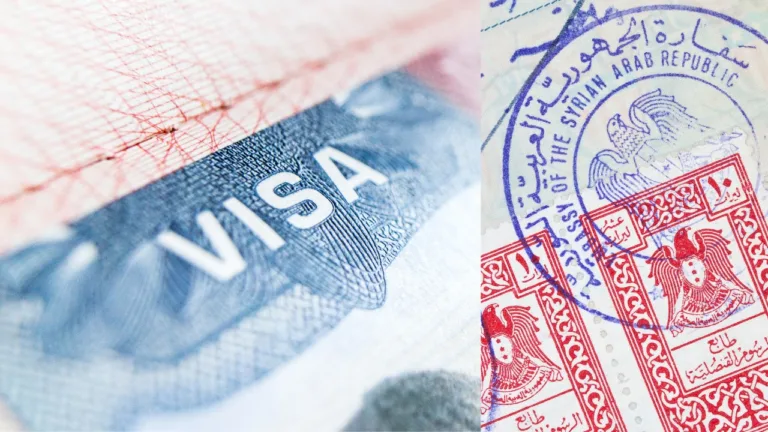
Crossing formalities: your passport is stamped on the Lebanese side on the way out, then on the Syrian side after you pay the visa fee in cash in dollars.
Important for the return journey: Lebanon has imposed a mandatory entry stamp fee on all non-Lebanese entering overland, of one million Lebanese pounds (about $11–12), paid in cash at the border. Budget for it if you will be leaving Syria for Lebanon overland, whatever way you originally entered.
The land crossing from Jordan
The Nassib – Jaber crossing is the only official crossing in operation between Syria and Jordan, and it sits about 100 km north of Amman. It operates around the clock since the Jordanian authorities decided to run it 24/7 from 23 March 2026, after investment was allocated to upgrading its facilities.
The crossing is a practical option if you are starting from Amman, but be aware that formalities can take considerably longer than at the Lebanese border. Allow half a day and build that into your schedule.
The land crossing from Iraq
The Bukamal – Qaim crossing is the main crossing between Syria and Iraq, and it reopened in June 2025. Crossing here is possible for tourists and the same visa fees apply, but it is not commonly used and security concerns remain in the eastern regions. We do not recommend it as a first choice for a tourist route.
The Turkish crossings: why they do not work for foreign tourists
This is a point of frequent confusion. The crossings between Turkey and Syria — Bab al-Hawa, Bab al-Salama, Kasab, Jarablus, Al-Rai and Tell Abyad — are not generally open to foreign tourists. Their traffic is mainly reserved for Syrians (including returnees), Turkish citizens, and specific categories.
For context: the Bab al-Hawa crossing sits about 50 km west of Aleppo and links the Syrian M45 road with the Turkish D827; the nearest Turkish town is Reyhanlı in Hatay province.
If you are coming from Turkey on a foreign passport, the correct route is to fly to Damascus or Aleppo (the Istanbul routes are numerous and relatively stable), or to enter overland through Lebanon or Jordan.
Arriving by sea
The ports of Latakia and Tartus handle limited passenger traffic and returnees. In practice, this is not a route you can plan a trip around — there are no regular ferry services you can rely on for a tourist journey.
Which Syria travel route suits you?
| Where you start | Recommended route | Alternative |
|---|---|---|
| The Gulf (Saudi Arabia, UAE, Qatar, Kuwait) | Direct flight to Damascus | Via Amman, then overland at Nassib–Jaber |
| Turkey | Istanbul–Damascus or Istanbul–Aleppo by air | No overland alternative for foreigners |
| Europe | Istanbul or Doha then Damascus, or Bucharest direct | Beirut then overland at Masnaa |
| Jordan | Nassib–Jaber overland, or Amman–Damascus by air | — |
| Lebanon | Masnaa–Jdeidat Yabous overland | Beirut–Damascus by air |
| Egypt and North Africa | By air via Doha or Istanbul | Beirut then overland |
From the airport to your hotel
Damascus International Airport is about 25–30 km from the city centre. Do not count on there being ready, reliable transport waiting once you are through passport control — this is exactly the point that catches many travellers out.
The options:
- A pre-arranged pick-up from your tour operator — the best and safest, at a price agreed in advance.
- A private car arranged through the hotel — set it up before you travel, by email or WhatsApp.
- Airport cars — available, but agree the price before you set off and do not rely on a meter.
Have small cash ready, and do not assume there will be an ATM that accepts your international card.
Frequently asked questions
Is Damascus airport operating now?
Yes. Damascus International Airport returned to regular operation on 8 April 2026 after the reopening of Syrian airspace, and several airlines run scheduled flights to it. But schedules are subject to change — check before booking.
Are there direct flights from the Gulf to Damascus?
Yes. From Riyadh and Jeddah (flynas and flyadeal), from Doha (Qatar Airways), from Abu Dhabi (Etihad), from Kuwait (Kuwait Airways), and from Sharjah to Aleppo (Air Arabia).
What is the easiest land crossing into Syria?
The Masnaa – Jdeidat Yabous crossing with Lebanon, which is the most used and the quickest to clear for most travellers heading to Damascus.
Can a foreign tourist enter Syria from Turkey?
Generally no. The Turkish crossings are reserved for Syrians, Turks and specific categories. Fly to Damascus or Aleppo instead.
Do I need a visa before arrival, or do I get it at the crossing?
The fee is paid at the point of entry, but the airline may refuse to board you without a prior approval document. The full detail is in the Syria visa guide.
How long does the land crossing take?
From an hour to several hours depending on the crossing and how busy it is. The Jordanian border usually takes longer than the Lebanese one.
Before you book: a checklist
- Check that the flight appears in the airline’s own official reservation system
- A changeable or refundable ticket
- Confirm the arrival airport with your tour operator
- The visa approval document before the day of travel
- Cash in dollars for the visa fee, plus one million Lebanese pounds if you will be returning overland through Lebanon
- Transport from the airport to the hotel arranged in advance
- A backup overland exit plan
Next step: read the Syria visa guide, then the first-time guide to the historic Damascus old city.