This guide gathers what you need to know before planning a Syria winter trip built around snow: when the snow actually falls, where it falls, how long it stays on the ground, and what usually ruins these trips.
People who know the country from the inside know it has another face, one that only shows between December and February: mountain ranges running from the far north-west down to the edges of the Hawran, peaks that whiten every winter, and villages known for generations as summer retreats that turn into snow destinations without anyone having to leave the country.
The Syria winter snow season: when does snow fall?
Snow in Syria is seasonal and irregular. It does not accumulate gradually over months the way it does in the European highlands. It arrives in short waves tied to depressions coming in off the eastern Mediterranean. A single wave lasts two to four days, then the sun returns and the melt begins.
- November: mostly rain. Snow is rare, and only on the high peaks.
- December: the start of the season. Snow above roughly 1,200 metres, and it usually does not last long.
- January: the peak of the season. The strongest and most settled waves, and the best month for anyone planning a trip specifically for snow.
- February: close to January, and often carries the heaviest fall of the year.
- March: late waves on the summits only, melting within days.
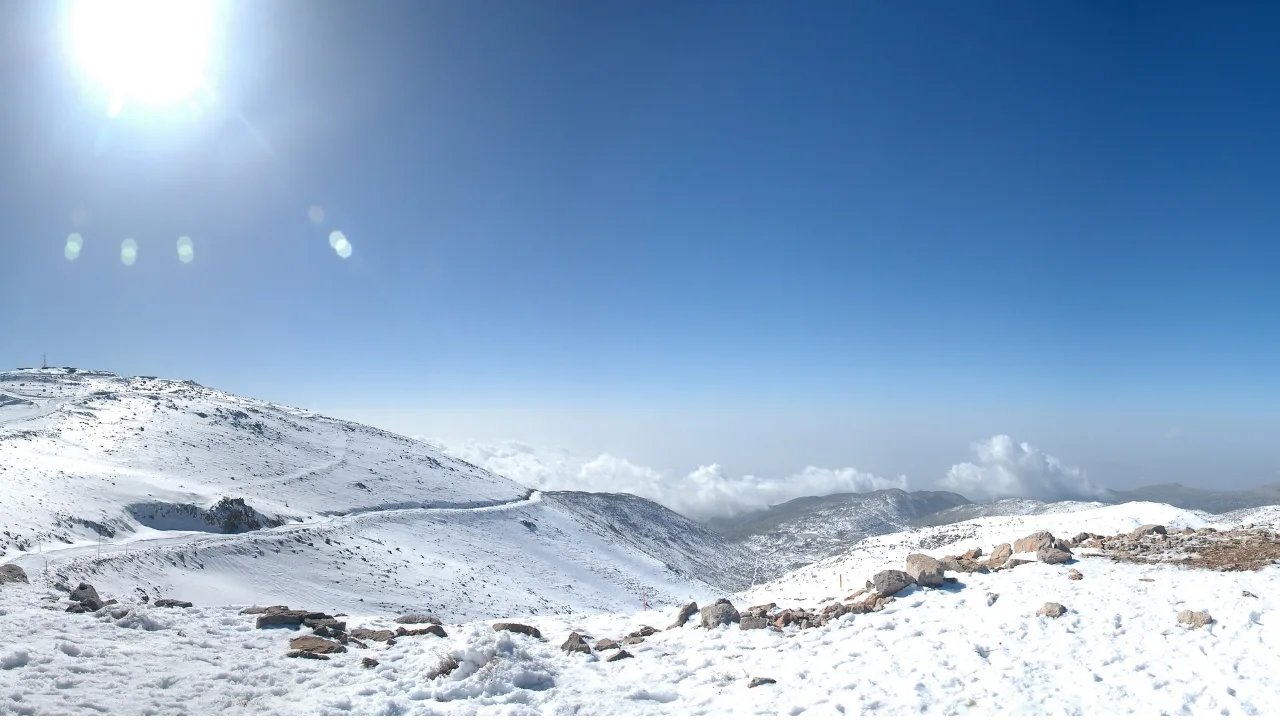
The practical rule: the higher a place sits above 1,000 metres, the better the chance that snow will settle on the ground instead of melting within hours of falling.
The snow map: where can you see it?
Slunfeh — the coast’s snow
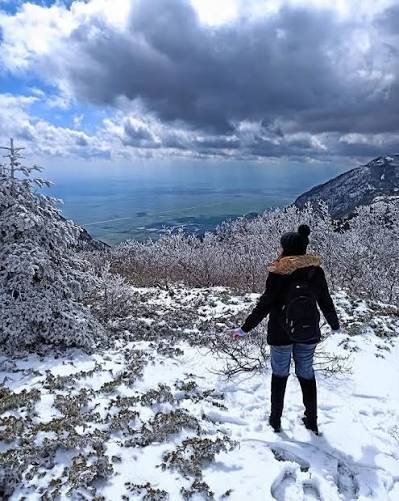
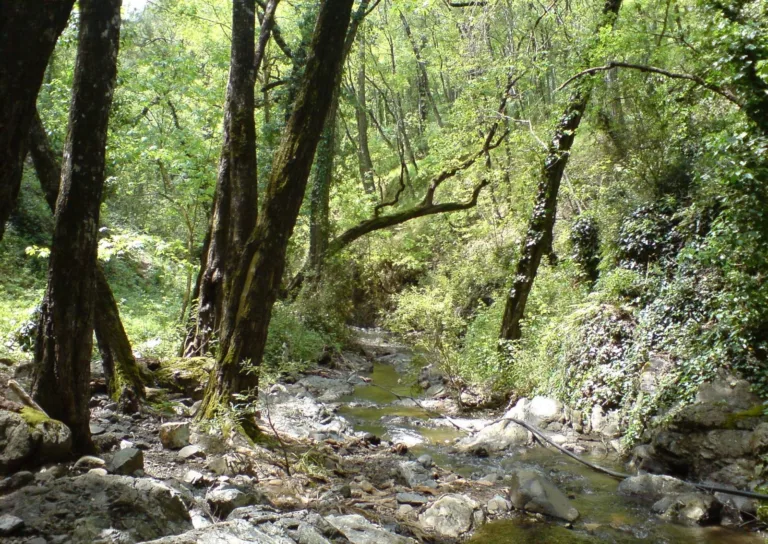
Slunfeh sits at around 1,300 metres in the Latakia mountains, among dense pine forest. For decades it has been known as a summer resort, but winter is its unknown season: the forest itself under snow, the mountain air after a storm has passed, and a road that climbs from the warm coast into full whiteness in under an hour and a half. It is the most practical destination for anyone setting out from Latakia or Tartus.
Weekend guide to Slunfeh in winter
Bloudan — the closest snow to Damascus
At roughly 1,500 metres in the eastern Lebanon range, and only a short distance from Damascus, Bloudan is the easiest snow destination for people living in or visiting the capital. Its altitude makes it one of the first places to whiten in every wave, and one of the last to melt.
Zabadani
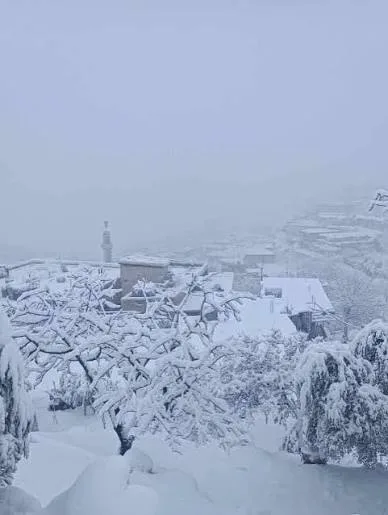
A valley lying at about 1,100 metres, known historically for its apples, its springs and its air. In the stronger waves the snow covers the whole floor of the valley, one of the finest winter scenes in the Damascus countryside. It should be said plainly that the town was badly damaged during the war years and that its tourism infrastructure is recovering gradually, so it is worth confirming in advance what services are actually available.
A one-day trip from Damascus to Bloudan and Zabadani
Kasab — snow on the border
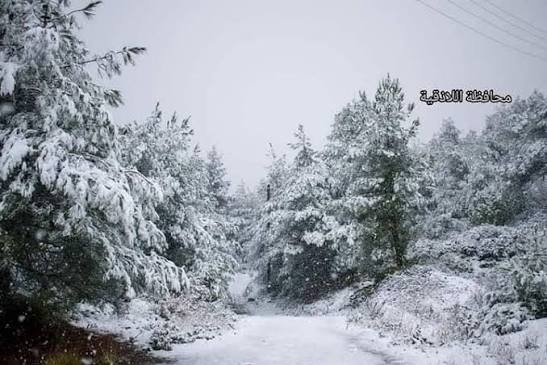
An old Armenian town in the far north-west of the country, at around 800 metres, surrounded by apple orchards and thick forest. Snow is less settled here than at Slunfeh because the altitude is lower, but the heights around it — Mount Aqra among them — do whiten in the stronger waves, and they give the view a contrast you rarely get anywhere else: sea on the horizon and snow on the mountain.
Mashta al-Helou — the rare snow of Tartus
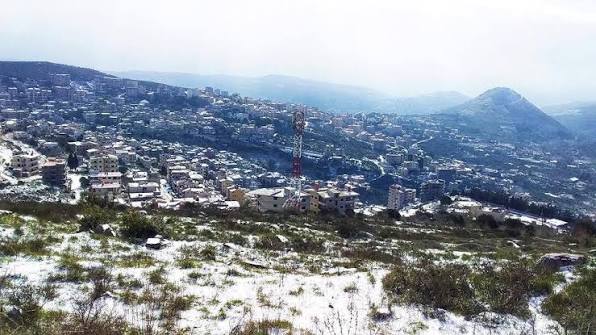
The altitude here is lower, and snow is a rare guest that stays no more than a day or two in the year. But the place earns a winter visit for a different reason: its cave. Caves hold a more or less constant temperature year round, which makes visiting one in the cold more comfortable than visiting it in summer.
The Qalamoun mountains — Yabroud, Assal al-Ward and Rankous
The mountain villages along the Damascus–Homs axis sit at useful altitudes and take their share of every wave. They are the option for anyone who wants a snow scene on the way through without devoting a whole trip to it.
Mount Hermon — the highest and the hardest
The highest summit in Syria and the one that holds snow longest; the white stays on its top for months after it has gone everywhere else. It is not, however, a tourist destination: access to it is restricted and there are no visitor services of any kind. It is mentioned here because it belongs on the country’s snow map, not as a trip you can plan.
How long does the snow stay on the ground?
This is the question that spoils most snow trips in Syria. At 1,300 to 1,500 metres, snow lasts between two and five days after a good wave before it starts to retreat. On the higher summits it lasts weeks.
In practice this means a snow trip in Syria is not something you book a month ahead. You prepare it in advance — the clothing, the gear, the destination — then you wait for the depression and move within 24 to 48 hours of its end. Setting out during the storm itself is a bad idea; setting out the day after it is the golden window: fresh snow, clear sky, open road.
The roads: the part that ruins trips
Syria’s mountain roads are narrow and winding, and many of them have no barrier along the edge. At the height of a wave some sections close temporarily, or vehicles that are not properly equipped are turned back.
- Check the state of the road on the morning of the trip, not days in advance.
- Snow chains or winter tyres are a necessity rather than a luxury on the higher sections.
- Avoid mountain driving at night in winter; thin ice on the asphalt cannot be seen.
- Fill the tank before the climb, not at the top.
What to pack for a snow trip in Syria
- Layers rather than one thick coat: a thermal base layer, wool, then a waterproof outer shell.
- Waterproof boots with a coarse sole. Ordinary trainers turn into a liability within minutes.
- Gloves and a hat that covers the ears. Most of the cold you feel starts at the extremities.
- Sunglasses — sunlight reflecting off snow is strong and tiring for the eyes.
- A power bank; cold drains a phone’s charge about twice as fast.
- Water, light food and a blanket in the car in case the road is delayed.
- Enough cash in hand, since electronic payment cannot be relied on in the mountain villages.
Frequently asked questions
Does it snow in Damascus?
Yes, but rarely and lightly, and it usually does not hold for more than a few hours. The real snow scenery is in the heights around the city, the nearest of which is Bloudan.
Does snow fall on the Syrian coast?
It does not fall on the cities of Latakia and Tartus except in very exceptional cases, but the mountains immediately behind them — Slunfeh and its surroundings — whiten every winter.
What is the nearest snow destination to Damascus?
Bloudan, then Zabadani. Both fit inside a one-day round trip.
What is the best month for a snow trip?
January and February, watching the depressions and moving as soon as a wave has passed.
Is there skiing in Syria?
There are no ski resorts in the usual sense of the word. The details are in the guide to snow with the family.