
Syria nature is more varied than most visitors expect: cedar and fir forests, mountain ridges with long views, and waterfalls in the far south. This article is a short tour of five of the country’s finest natural areas.
The Fir and Cedar Reserve: one of Syria’s largest nature reserves

East of Latakia, about 50 km from the coast, the Cedar and Fir Reserve sits in the Slunfeh area. It is one of the largest and most varied of Syria’s nature reserves.
The reserve runs from 1,000 metres up to 1,500 metres above sea level, which gives it an unusual range of plants and animals. It holds one of the largest fir and cedar forests in Syria, a reminder that this region once supplied the timber for the Phoenician ships that sailed the ancient world, carrying the country’s culture with them.
Dozens of guesthouses and small hotels are spread around the reserve and in the neighbouring villages, so a longer stay is genuinely worth considering here.
The best thing to do is simply walk, and walk a long way. The detail of the fir and cedar forest does not come across in a photograph or a short description, and it is not easy to leave once you are deep inside it, so give yourself enough time. If you like being outdoors, you can camp here too.
On the reserve’s eastern slope you get one of the finest views in Syria. The Ghab plain stretches away to the east like a painting, the colours of the crops running together across the flat land. Your eye travels as far as it can, with nothing to stop it except the mist, when it swallows the plain in winter weather. That is another kind of magic again.
Al-Mawla Hassan Forest in Qadmus

Al-Mawla Hassan forest is about 60 km from Tartus, on a hilltop with a wide view over much of the Syrian coast. The forest sits above Qadmus and is made up of cedar, pine and chestnut trees, which makes it an ideal place to spend time in the open air.
At its centre stands a small historic shrine, which gave the forest its name. Near the entrance is the eco-camp, a cluster of wooden cabins built from timber cut in the forest itself and designed for visitors, camping groups and anyone who likes living outdoors.
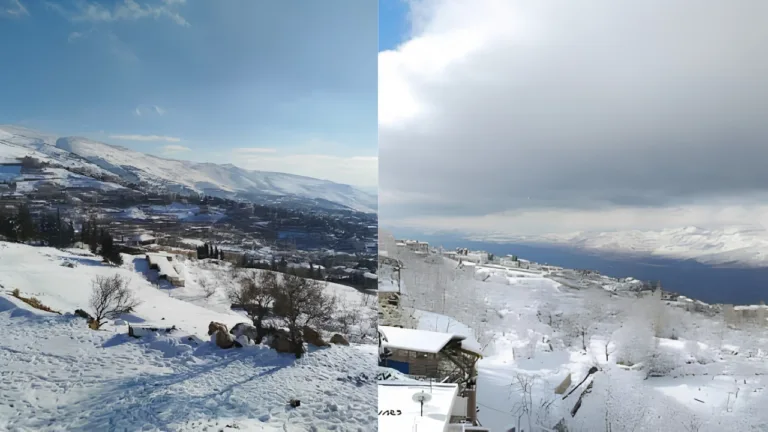
What sets this forest apart is how steeply it drops away and how tall the trees are, which gives it the look of a Swiss forest, especially in winter when snow takes over and draws its own patterns across the branches.
If you come in autumn, make sure you get your share of the chestnuts, which are Al-Mawla Hassan’s speciality. And bring warm clothes: heat has long been banned up here.
The Frunloq forests

In the far north of Latakia province, on the Syrian-Turkish border, the Frunloq forests are living proof of how beautiful Syria’s natural landscape can be. The forest is about 40 km from the city of Latakia, the road to it is in good condition, and several villages around it compete over who has the better view and the more generous welcome.
The forest itself is one of the largest natural forests in Syria and still shelters hundreds of species of birds, which give the place much of its character, along with smaller numbers of other wild animals and some rare plants and fungi. What stands out most at Frunloq is how many local springs it has, which makes it a rare find for anyone who loves nature and quiet. You can lose a whole day here in the shade of the trees, alone with the landscape, until you forget that time is still moving.
The best things to do are hiking in the heart of the forest and camping. Several well-serviced spots have appeared recently, catering to tourists, adventurers and nature lovers, and volunteer groups and local walking enthusiasts organise hikes here regularly.
Dahr al-Qusayr forest

Halfway along the road between Homs and Tartus, a wide forest of pine, cypress, oak and chestnut spreads along the mountainside. Those trees are what give the forest its distinctive autumn colours.
Dahr al-Qusayr is one of the most beautiful forests in Syria, and perhaps its greatest advantage is how close it is to areas that are already busy with visitors and to the main roads, while still keeping a good deal of its own character as a quiet pocket of open country away from the noise.
At Dahr al-Qusayr you can steal a few hours of quiet, or have a proper picnic out in the countryside, without setting aside a long stretch of time or any special preparation. Sitting as it does between Tartus, Homs and Hama, and with service facilities in and around the forest, Dahr al-Qusayr gives you a trip into real countryside without taking over your whole schedule.
Tell Shihab waterfalls

Away from the forests, in the far south of Syria and about 17 km west of the city of Daraa, the Tell Shihab waterfalls drop off the edge of an escarpment and make the finest sight in Daraa province, close to the Syrian-Jordanian border.
The water comes off the edge of the town of Tell Shihab and falls into the Yarmouk valley, spreading life along the length of the border valley.
Unlike the usual flat farmland of the Hauran region, the Yarmouk valley stands out as something quite different. Beyond the valley itself and the striking fall of its water, there is the picture the water has painted in the valley, turning it into a green paradise hidden from view down below.
The valley once played an important economic role in the surrounding area, and the falls were used to drive the old water mills, which left the area full of remains from the civilisations that passed through it. The most notable is the bridge still standing today, along with what is left of the mills, though what endures above all is the sheer beauty of the falls when the water is running.
So if you want a change from forests, go and see the Yarmouk valley and enjoy the Tell Shihab waterfalls. And remember that the best time to visit is spring, when the whole landscape bursts into life and the falls are at their most impressive.