Palmyra, known in Arabic as Tadmor, was the most visited site in Syria before 2011 and the most damaged after it. Today it is visitable again, largely empty, and still one of the most extraordinary Roman-era cities anywhere. This guide covers the practical side: how to get there, what is actually left, how access works right now, and how to plan a day among the ruins.
Palmyra at a glance
| Location | Homs Governorate, about 215 km northeast of Damascus and 150 km east of Homs |
| Status | UNESCO World Heritage Site (listed 1980, on the endangered list since 2013) |
| Access | Open; no formal ticketing at the time of writing (see below) |
| Time needed | A full day on site; overnight recommended for sunrise and sunset |
| Best season | March–May and October–November |
Is Palmyra open to visitors?
Yes. Independent travellers and tour groups have been visiting since Syria reopened to international tourism in 2025. Visitor numbers are very low — locals reported fewer than twenty tourists a day in late 2025 — and the site is not yet run as a conventional attraction. As of late 2025 there was no admission fee and the archaeological area was freely accessible; a tiered heritage-site pricing scheme came into effect in Syria in January 2026, so confirm whether Palmyra now charges entry before publishing.
The modern town and the archaeological zone remain a military-administered area. In practice this means checkpoints on the road in, and in some periods an escort or a guard accompanying visitors through the site. Travelling with a licensed Syrian agency simplifies all of this considerably; our Syria visa guide covers the paperwork you need before arrival.
Getting to Palmyra
From Damascus
The drive takes 3.5 to 4 hours via the Homs highway and then the desert road east. There is no scheduled bus service worth relying on; a private car with driver or an agency tour is the standard option. Day trips from Damascus are possible but mean seven to eight hours on the road for four hours on site — an overnight is a much better experience.
From Homs
About two hours east across open desert. Homs is the natural base if you are combining Palmyra with Krak des Chevaliers and the Homs countryside.
Practicalities on the road
- Carry your passport and visa documentation; expect checkpoints.
- Fuel up before leaving Homs; services on the desert road are sparse.
- Bring more water than you think you need. There is almost no shade on site.
- Mobile coverage is patchy in the desert — see our guide to internet in Syria.
What survived — and what didn’t
Understanding the damage helps set expectations. Palmyra was occupied twice by ISIS (2015 and 2016–17) and was a frontline for years. A survey by the American Society of Overseas Research concluded that military activity caused more damage than deliberate destruction, but the deliberate losses were the most famous monuments.
| Monument | Condition today |
|---|---|
| Temple of Bel | Cella (main building) destroyed in 2015; the massive enclosure walls and monumental gate still stand |
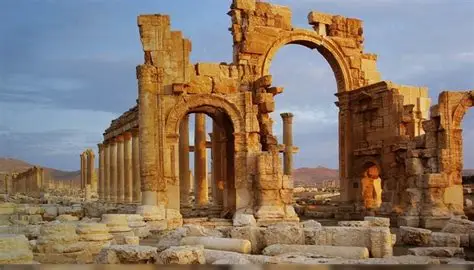
| Monumental Arch | Destroyed 2015; reconstruction plans announced — confirm current status |
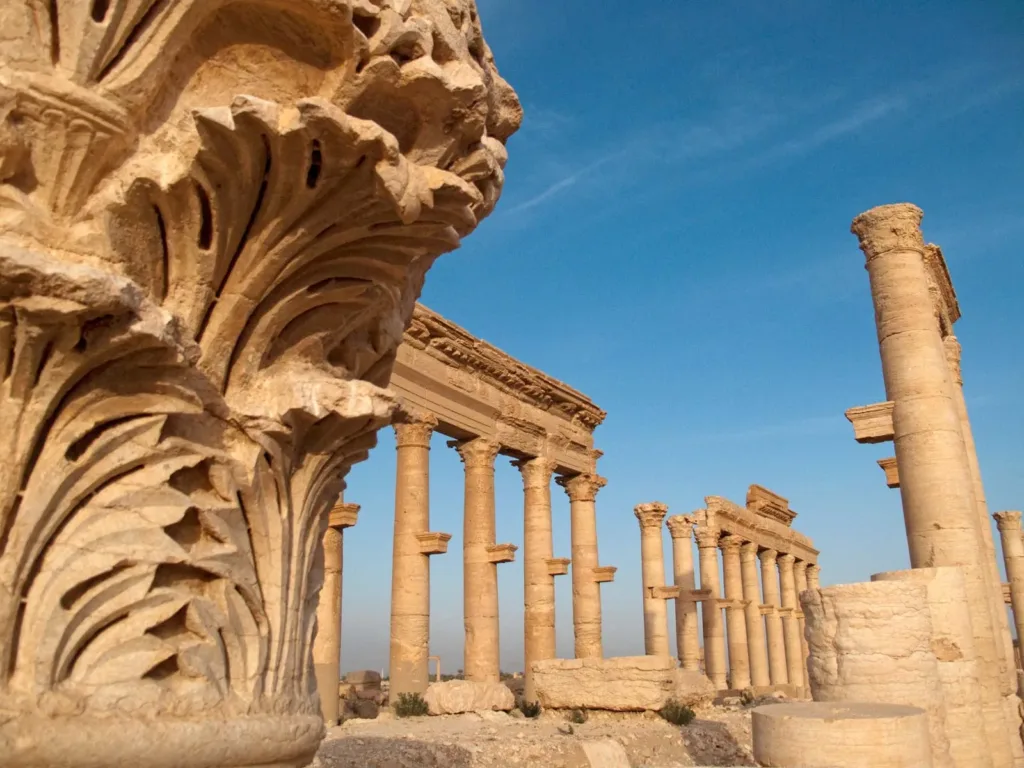
| Great Colonnade | Largely intact; the 1.1 km street is still the spine of the site |
| Tetrapylon | Heavily damaged 2017; partial columns remain |
| Roman Theatre | Structurally intact; used by ISIS for executions, now open |
| Temple of Baalshamin | Destroyed 2015 |
| Valley of the Tombs | Several tower tombs blown up; others standing. Hypogeum of the Three Brothers closed for repair |
| Fakhr-al-Din Castle | Damaged but intact; best viewpoint over the site |
| Palmyra Museum | Closed; collection partly evacuated to Damascus |
A walking route through the ruins
- Start at the Temple of Bel at the eastern end. Even without its cella, the scale of the sanctuary walls is the best introduction to what Palmyra was.
- Walk west along the Great Colonnade. Look for the brackets on each column where statues of merchants and benefactors once stood, and the Aramaic-Greek inscriptions naming them.
- The Theatre and the Agora sit just south of the colonnade about halfway along.
- Continue to the Tetrapylon and the Camp of Diocletian at the western end.
- Turn south to the Valley of the Tombs for the funerary towers — late afternoon light is best here.
- End at Fakhr-al-Din Castle on the hill for sunset over the whole city and the oasis.
Allow six hours for this at a comfortable pace. A local guide is strongly recommended: the site has almost no signage, and guides who grew up here bring the ruins to life in a way no leaflet can.
Where to stay and eat
The pre-war hotel strip next to the ruins was destroyed and the modern town is only partly resettled. Accommodation currently consists of a small number of basic guesthouses and family-run rooms in Tadmor town; list current names and contacts at publication. Many visitors stay in Homs and drive in early. Food options in town are simple — grilled meat, kebab, salads — and you should bring snacks and water for the site itself.
Safety and responsible visiting
- Check your government’s travel advisory and your insurance terms before travelling; most Western advisories still recommend against travel to Syria.
- Stay on established paths. Areas of the desert around Palmyra were mined during the conflict, and clearance is ongoing.
- Do not climb on damaged structures or move stones — much of the site is an active conservation zone.
- Photography is fine on site; do not photograph military positions or checkpoints. Drones require permission.
- Hire local guides and buy from local vendors. Tourism is one of the few income sources the town has left.
A short history
An oasis settlement for millennia, Palmyra became rich in the 1st–3rd centuries CE as a caravan city between Rome and Parthia, taxing the silk and spice trade that crossed the desert. Its merchants built temples in a hybrid Greco-Roman-Semitic style found nowhere else. Under Queen Zenobia the city briefly ruled an empire from Egypt to Anatolia before Rome crushed it in 273 CE. It never recovered its wealth, which is precisely why so much of the Roman city survived intact until the 21st century.
FAQ
Is Palmyra safe to visit?
Visitors have been travelling there with agencies and independently since 2025 without incident, but the wider security picture in Syria changes, and you should read current advisories. Going with a licensed agency, staying on marked paths and following instructions at checkpoints are the sensible precautions.
How far is Palmyra from Damascus?
About 215 km — 3.5 to 4 hours by car.
Can I visit Palmyra as a day trip?
From Homs, comfortably. From Damascus, it is a long day; an overnight in Tadmor or Homs is better.
Is there an entrance fee?
No fee was charged as of late 2025. Syria introduced tiered heritage-site pricing in January 2026 — check the current position before you go.
Palmyra features in our central Syria itineraries. Build your own route with the Travel963 trip designer in two minutes, or ask us for a guided Palmyra–Homs–Krak programme with driver.